Guide to Effective Meta Descriptions
Learn how to craft effective meta descriptions that improve SEO and increase click-through rates for your website.
This is called your Slug: guide-effective-meta-descriptions
This is your Focus KeyPhrase: effective meta descriptions
- SEO best practices
- meta description examples
- increase click-through rates
- Search engine results page with highlighted meta descriptions
- Infographic with tips for writing effective meta descriptions
- Checklist of best practices for crafting SEO-friendly meta descriptions

In addition to writing or wanting to learn how to write meta descriptions, our optimizer does it for you.
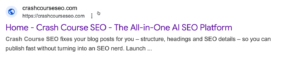 As a result you will see after the colored title you will see a description that says “Crash Course SEO fixes your blog posts for you – structure, headings and SEO details – so you can publish fast without turning into an SEO nerd. Launch ..” That my friends is called a Meta description.
Understanding Meta Descriptions
To begin with, a meta description is a brief summary of a webpage’s content. Consequently, it serves as an advertisement for the page in search engine results.
Moreover, search engines like Google often display this summary below the page title. Therefore, crafting an engaging and informative meta description is crucial for attracting clicks.
Additionally, it should be concise, typically between 150-160 characters. This character limit ensures that the entire description is visible in search results without being cut off.
Furthermore, including relevant keywords can enhance visibility in search queries. However, it is essential to avoid keyword stuffing, as this can lead to penalties from search engines.
The Importance of Meta Descriptions in SEO
Moreover, effective meta descriptions play a significant role in improving click-through rates (CTR). When users see a compelling description, they are more likely to click on the link.
Consequently, higher CTR can lead to improved rankings in search engine results pages (SERPs). Additionally, a well-written meta description can differentiate your content from competitors.
For example, if two pages rank similarly, the one with a more engaging description may attract more clicks. Therefore, it is crucial to view meta descriptions as part of your overall SEO strategy.
Moreover, they can influence user behavior and perceptions about your brand. As a result, investing time in crafting effective descriptions can yield significant returns.
Best Practices for Writing Meta Descriptions
To create effective meta descriptions, start by focusing on clarity and relevance.
Therefore, ensure that the description accurately reflects the content of the page. Additionally, use action-oriented language to encourage users to click through.
For instance, phrases like “Discover,” “Learn,” or “Find out” can be very effective. Moreover, consider including a call to action (CTA) within your description.
This approach can motivate users to take the next step after reading your summary. Furthermore, avoid using generic phrases that do not provide specific information about your content.
Instead, tailor each description to match the unique value proposition of each page.
Examples of Effective Meta Descriptions
For instance, an effective meta description for a recipe blog might read: “Discover quick and easy recipes for busy weeknights that your family will love.”
Consequently, this description clearly communicates what users can expect while enticing them with the promise of quick solutions.
Additionally, another example could be: “Learn how to boost your productivity with these simple tips and tricks.”
This statement not only informs but also encourages readers to find out more.
Therefore, analyzing successful examples can provide valuable insights into crafting your own descriptions.
Moreover, consider experimenting with different styles and formats to see what resonates best with your audience.
A/B Testing Your Meta Descriptions
Furthermore, A/B testing can be an invaluable tool when optimizing your meta descriptions.
By creating variations of a single description and measuring their performance, you can determine which one yields better results.
Consequently, this data-driven approach allows you to refine your strategies over time. Additionally, consider testing different lengths and wording styles to see what captures attention most effectively.
For example, you might find that shorter descriptions perform better than longer ones in certain contexts.
Moreover, keep track of changes in CTR after implementing new descriptions to gauge their effectiveness accurately.
FAQ
- Q: What is the ideal length for a meta description?
A: The ideal length is typically between 150-160 characters. - Q: Can I use keywords in my meta description?
A: Yes, using relevant keywords can help improve visibility but avoid keyword stuffing. - Q: Should I write unique meta descriptions for every page?
A: Yes, unique descriptions tailored to each page’s content are recommended.
Internal link suggestions
External link suggestions
- Google’s guide on SEO basics
- Moz’s beginner’s guide to SEO